
The AI Job Revolution in 2026: What Will Happen to Our Jobs?
Artificial intelligence is no longer “something coming in the future.” It’s already here. And every single week, I see people getting scared, excited, confused, and even overwhelmed by how fast things are moving. I get it — even in my own work, AI has changed the way I operate so drastically that sometimes I look back and wonder how work even looked before all of these tools existed.
But instead of fearing AI, I decided to study it, adapt to it, and use it to multiply what I can do. This is my personal breakdown of how AI is reshaping jobs, based on what I see in real-life workflows, businesses I handle, and the big shifts happening across industries.

AI Is Not Taking All Jobs — It’s Reorganizing Them
One thing I’ve learned is this:
AI doesn’t replace jobs. It replaces tasks. And people who master AI will replace people who don’t.
Some jobs, yes — they’re on the chopping block because the tasks are repetitive, predictable, and easy for machines to automate. But other jobs become more valuable because AI becomes an assistant, a multiplier, or a second brain that helps you operate faster than ever.
To make this clear, I’ll break down three major categories:
Jobs AI will replace
Jobs AI will transform
New jobs AI will create
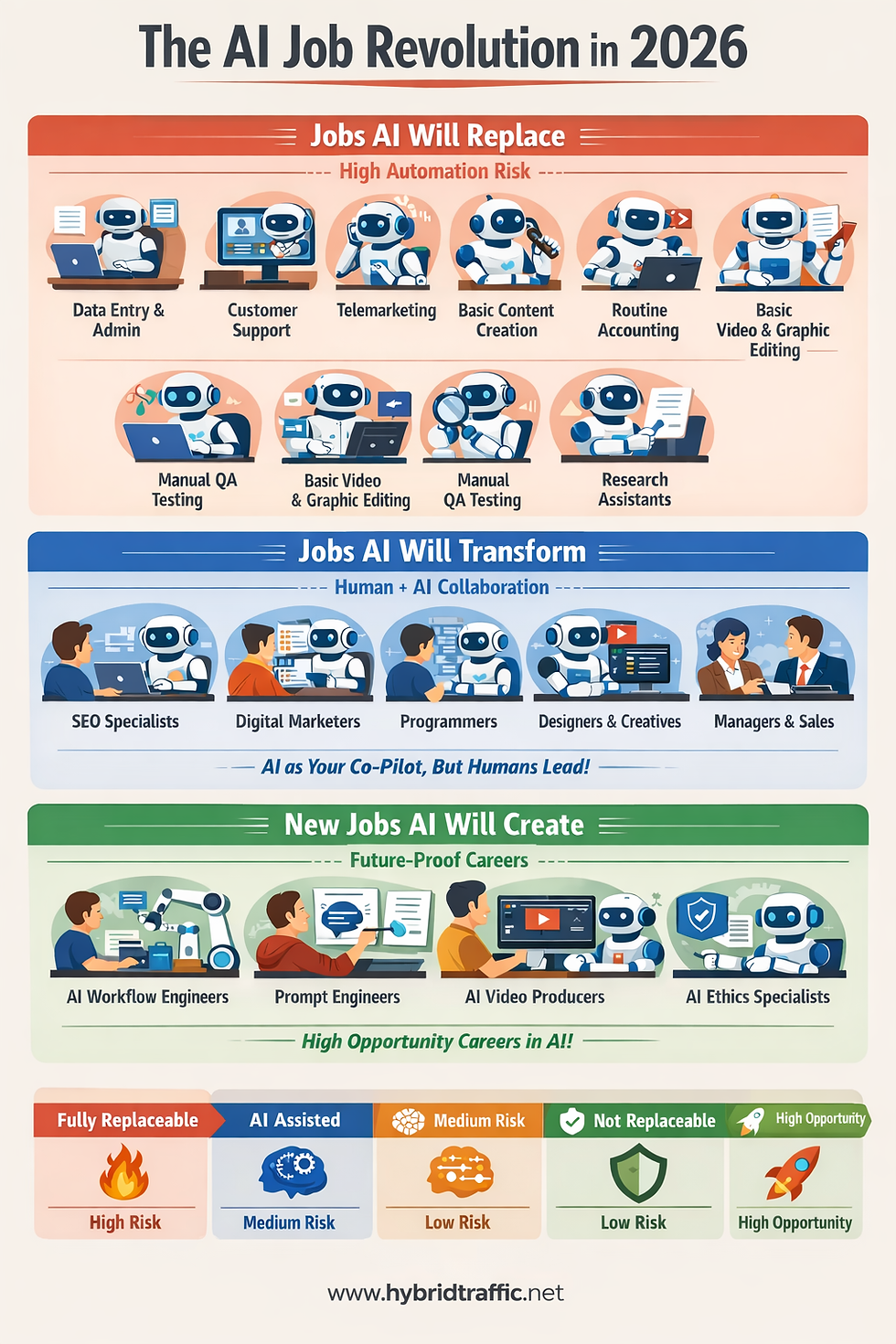
1. Jobs AI Will Replace (High Automation Risk)
There are industries where AI can perform the work more efficiently, more accurately, and at a fraction of the cost. These are roles where people spend most of their day doing repetitive administrative processes or following scripts.
Data Entry & Admin Work
This is the first category AI will completely disrupt. If your job involves copy-paste, form filling, or updating rows in a database — AI does that in seconds without fatigue.
I’ve personally automated tasks like:
pulling data from websites
converting reports
formatting spreadsheets
What used to take hours now takes minutes.
Customer Support (Basic)
AI chatbots can respond instantly, handle large volumes, and even translate languages on the fly. For basic queries, FAQs, order status, and simple troubleshooting, AI is already outperforming humans.
The only support roles that survive are those involving:
complex problem-solving
emotional handling
escalations
Telemarketing & Appointment Setting
AI voice agents now sound almost human. They can:
follow call scripts,
capture information,
adjust tone based on emotion detection.
Businesses that rely heavily on outbound calling will move to AI-based systems because they’re cheaper and more scalable.
Basic Content Creation
This is ironic because I produce a lot of content — but even I know AI can now generate:
product descriptions
social captions
simple blog drafts
ad copies
But here’s the real difference: AI content is generic. Human content is emotional, strategic, and persuasive.
This is one of the reasons strategists, editors, and storytellers become more valuable later on.
Routine Accounting Tasks
Bookkeeping, invoice scanning, payroll verification — these are already being automated inside accounting software.
Accountants themselves won’t disappear, but the administrative parts of their work will.
Basic Graphic & Video Editing
Tools like Canva AI, Runway, and Sora can now generate:
video scenes,
transitions,
captions,
motion graphics,
even product ads.
People who used to do simple edits will be replaced, but creative directors and high-level editors will still thrive.
Research Assistants
AI can digest thousands of pages faster than any human. When I research for SEO or market analysis, I can generate more insights in 30 minutes with AI than a researcher can in two days.
This makes the role less about gathering information and more about interpreting it.
2. Jobs AI Will Transform (Human + AI Collaboration)
These are the careers that won’t disappear — they will evolve. AI becomes a co-pilot, not a replacement.
In my own work, these are the jobs where I see AI making people 3–10x more productive.
SEO Specialists
This is literally my field. AI helps with:
keyword clustering
technical audits
content briefs
AEO/GEO optimization
internal linking mapping
entity building
But the human part — strategy, decision-making, brand voice, competitor analysis — that still cannot be replaced.
Digital Marketers
AI can:
automate A/B tests
generate ad variations
identify ideal audiences
optimize campaigns based on real-time data
But only marketers understand:
positioning
emotional targeting
brand storytelling
campaign direction
AI is the engine. Marketers are the drivers.
Programmers
AI writes code faster than any junior developer. But senior developers become super engineers because they can build amazing products with AI assistance.
Developers who resist AI will fall behind. Developers who embrace AI will build more powerful tools than ever.
Designers & Creatives
AI can generate drafts or initial concepts, but the designer:
chooses the style
ensures brand consistency
understands emotions
builds user experience
AI is a tool. Design is still human.
Managers, Sellers, Leaders
AI can support decision-making, but cannot replace:
trust
negotiation
leadership
conflict resolution
motivation
vision
These roles become even more important because the teams they manage are now part-human, part-AI.
3. New Jobs AI Will Create (Future-Proof Careers)
These are the exciting ones — new roles that didn’t exist 5 years ago.
AI Workflow Engineers
These people design systems where multiple AIs work together. This is one of the most in-demand jobs now.
Companies want to automate:
onboarding
customer support
lead management
reporting
content pipelines
I see this growing massively.
Prompt Engineers / AI Orchestration Experts
Prompting isn’t “typing clever prompts. ”It’s understanding:
model behaviour
constraints
creativity
memory
output shaping
As AI becomes more powerful, the people who know how to control it will be in high demand.
AI Video Producers
With tools like Sora, Runway, and Pika Labs exploding, the demand for AI-video creators is rising fast.
Content creators, brands, agencies — everyone wants fast, cinematic-quality videos.
AI SEO / AEO / GEO Specialists
This is the future of SEO. AI ranking depends on:
entity authority
citations
consistency
brand presence
outreach links
structured content
The people who master this will dominate AI search visibility.
AI Ethics & Safety Specialists
Governments will require compliance. Corporations will need ethical guardrails. This will become a major career path.
So What Does This Mean for Us?
Here’s the real truth I’ve learned:
AI won’t replace you. A person using AI will replace you.
That mindset changed how I work, build businesses, create content, and grow teams.
Instead of fighting the wave, I ride it.
How I Personally Use AI in My Own Work
Just to share a few examples:
I use AI to draft outlines, then I refine them.
I use AI to brainstorm, but I choose the best direction.
I use AI for technical SEO tasks, but I do the strategy.
I use AI to create concept visuals, but humans finalize quality.
I use AI to edit videos, but I shape the story.
AI is not a threat — it's a multiplier.
The people who will lose jobs are the ones who refuse to adapt. The people who will win are those who embrace AI and let it amplify their skills.
Final Thoughts: The Future Is Human + AI, Not Human vs. AI
If there’s one thing I want people to take away from this:
AI is not the end of jobs — it’s the evolution of work.
The world is shifting toward a hybrid model where:
AI handles the repetitive tasks,
Humans handle the emotional, strategic, creative, and relational work.
The combination is unstoppable.
And personally? I’m excited. Because I know that if I stay adaptive, curious, and open to learning, AI won’t replace me — it will empower me.
Comments